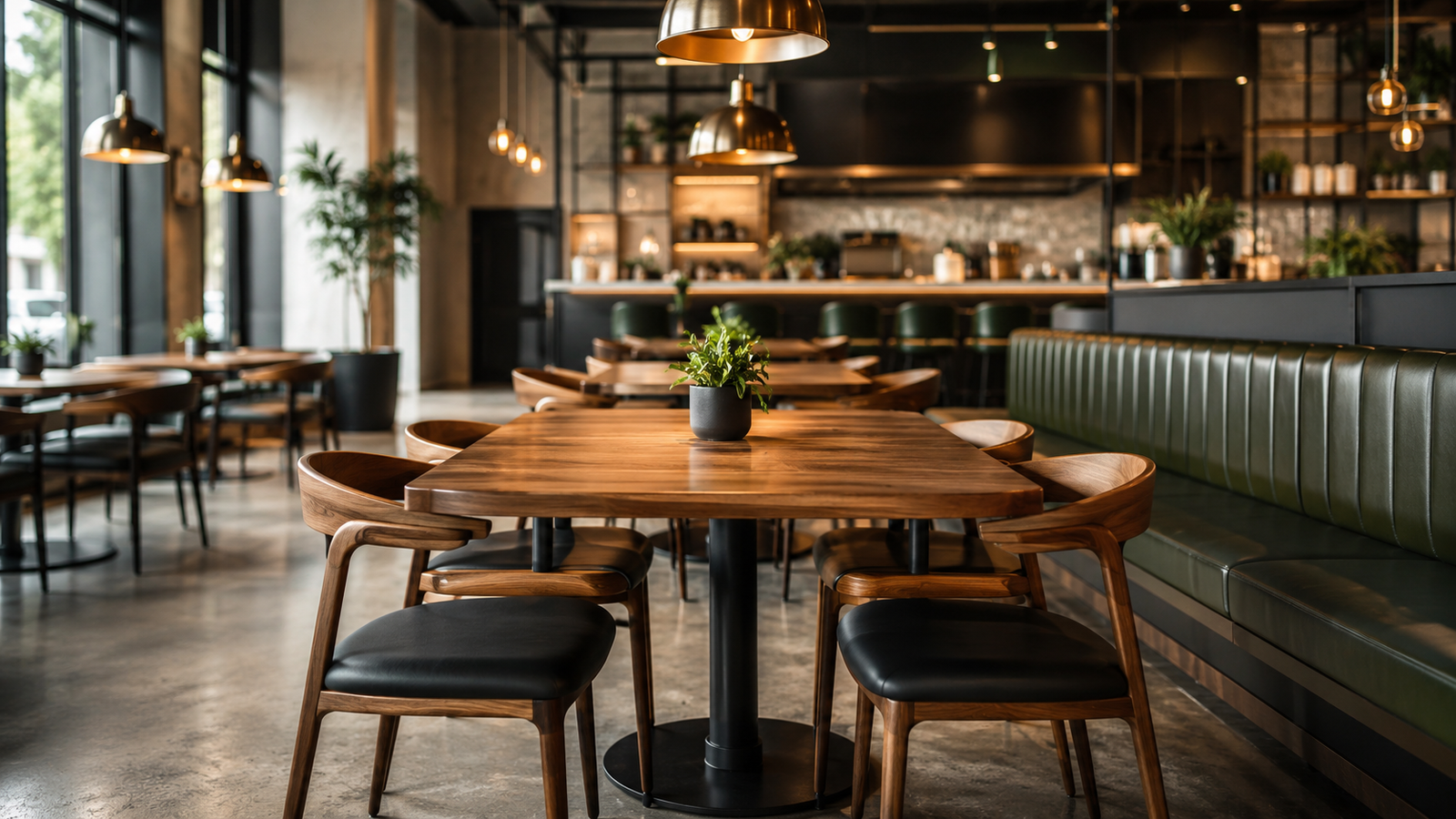
The core insight is that commercial restaurant furniture behaves like productive plant: it has an acquisition cost, a service life, a maintenance curve, and a measurable contribution to output. Model it that way and several conventional purchasing decisions reverse themselves immediately.
Setting Up the Model
Start with the variables any capital model needs. Acquisition cost per seat, expected service life in years, annual maintenance and repair, residual value at disposal, and the revenue capacity the configuration supports. None of these is exotic, and all of them are knowable to within useful tolerances.
Commercial-grade seating built to industry test standards commonly runs 7 to 10 years in full service. Residential-grade lookalikes in the same duty cycle fail in 1 to 3. Those two lifespans anchor everything that follows.
Annualized Cost Tells a Different Story Than Price
Divide each option’s all-in cost by its realistic life and the sticker-price ranking inverts. A $220 commercial chair over 8 years costs roughly $28 per year. A $90 lookalike over 2 years costs $45 per year before counting freight on the reorder, assembly labor, and the mismatch risk when the original line is discontinued.
- The cheap option costs about 60 percent more per year of service.
- Every replacement cycle adds downtime and staff hours the invoice never shows.
- Discontinued lines force whole-section replacements to keep the room coherent.
The payback period on the premium option, funded by the avoided replacements alone, typically lands inside 3 years. Everything after that is yield.
Revenue Capacity Belongs in the Model
Cost is half the equation. Configuration is the other half, because seat dimensions set cover counts. Trimming 2 inches of chair width across a room can recover a deuce or two, and a recovered deuce turning twice a night at modest average checks compounds into tens of thousands per year.
This is where furniture spending starts resembling capital expenditure in the formal sense: money deployed now to expand productive capacity later. An operator comparing two packages should be comparing their revenue ceilings, and the ceilings differ more often than the prices do.
The Maintenance Curve Is Predictable
Commercial furniture politely fails. Glides wear, upholstery panels reach reupholstery age at about the midway of frame life and finishes dull on a schedule roughly proportional to traffic. The fleet is maintained at full strength with a few percent per year of purchase expense.
Furniture unrated is a random nasty failure in front of guests. The distinction between the two failure modes is the difference between a budget line and a sequence of tiny emergencies and emergencies always cost more.
Residual Value Closes the Loop
Standardized commercial product enters a secondary liquid market at end of life. Rooms refit, and their fleets move on to cafes, breweries and start-ups for 10 to 20 percent of initial cost. Custom or flimsy product exits by dumpster, at a hauling fee.
Adding disposal converts specification options into liquidity decisions. The generic but sturdy package quietly bears a final value that the bespoke package never will.
What the Model Changes in Practice
Operators who run this exercise tend to make the same three moves. They standardize on fewer lines to simplify replacement and resale. They shift budget from private-room showpieces toward the high-traffic zones where duty cycles are brutal. And they time refits to depreciation schedules instead of to visible collapse, replacing from strength rather than emergency.
None of these moves requires new capital. They require only that the existing capital be visible, which is precisely what a model is for.
Stress-Testing the Assumptions
A model earns trust by surviving pessimism, so flex the inputs. Halve the expected service life: the commercial option still wins on annualized cost. Cut the revenue-capacity gain to a single recovered seat: the payback stretches but stays inside the holding period. Zero out residual value entirely: the ranking holds.
The conclusion is robustly boring, which is what a purchasing conclusion should be. Under almost any defensible set of assumptions, duty-rated product bought once outperforms cheap product bought repeatedly, and the spread widens with traffic. The only scenario where the lookalike wins is a venue that fails fast, and no one models for that on purpose.
A Balance Sheet You Can Sit On
The furniture in a dining room is the rare asset an owner can audit by walking through the building, and the rare one guests inspect nightly without knowing it. Modeling it costs an afternoon. Ignoring it costs a percentage point of margin that never announces itself.
Seven years is a long holding period. The operators who plan for all seven, in advance, on paper, are the ones for whom year seven arrives as a scheduled decision instead of a surprise invoice.