Concrete gets a bad reputation. People assume it’s durable enough on its own—that it can handle years of foot traffic, weather exposure, chemical spills, and the general wear of daily life without any help. But untreated concrete is quietly deteriorating beneath your feet, soaking up moisture, absorbing stains, and cracking under pressure.
That’s where concrete coating services come in. Not just as a protective layer, but as a complete transformation—one that changes how your surface looks, performs, and lasts. The difference between sealed and unsealed concrete isn’t subtle. It’s the difference between a surface that holds up and one that slowly falls apart.
Why Untreated Concrete Fails Faster Than You Think
Fresh concrete looks solid. It feels solid. But concrete is a porous material, which means it absorbs everything it encounters—water, oil, cleaning chemicals, and road salts. Over time, this absorption leads to surface erosion, staining, and structural cracking.
Freeze-thaw cycles make things worse. Water seeps into the pores, freezes, expands, and fractures the surface from within. In high-traffic environments—garage floors, driveways, commercial spaces, and warehouse floors—this process accelerates rapidly. What starts as a hairline crack becomes a full structural concern within a few seasons.
Coating the concrete seals those pores. It cuts off the cycle before it starts.
What Makes Carbon Concrete Coating Services Stand Out
Not all coating services deliver the same results. The quality of the product, the preparation process, and the application technique all determine how well the coating bonds—and how long it lasts.
Professional concrete coating services use high-performance systems that penetrate deep into the slab rather than sitting on the surface like a film. This creates a bond that resists peeling, bubbling, and delamination—common failure points in lower-quality coatings.
Polyaspartic and Epoxy Coatings: What’s the Difference?
Two of the most widely used concrete coating systems are epoxy and polyaspartic—and understanding the difference helps you choose the right solution for your surface.
Epoxy coatings are known for their exceptional adhesion and chemical resistance. They bond tightly to the concrete surface and create a hard, durable shell that holds up well in industrial and commercial settings. Cure time is longer, which allows for a thorough bond.
Polyaspartic coatings are a newer development. They cure faster, offer superior UV stability, and can be applied in a broader range of temperatures. For garage floors and exterior surfaces exposed to sunlight, polyaspartic is often the preferred choice—it won’t yellow or fade the way some epoxies do.
Many professional applications combine both: an epoxy base coat for adhesion and strength, topped with a polyaspartic topcoat for durability and appearance. The result is a surface system that performs in the toughest conditions.
The Surfaces That Benefit Most From Concrete Coatings
Concrete coatings aren’t limited to one type of setting. The service applies across a wide range of environments, each with its own specific demands.
Residential garages are one of the most popular applications. A coated garage floor resists tire marks, oil drips, and moisture—while transforming a dull grey slab into a clean, polished space that looks intentional.
Commercial and industrial floors face constant heavy traffic, equipment movement, and chemical exposure. A high-build coating system creates a surface that can handle the pressure without degrading.
Driveways and outdoor surfaces benefit from coatings that resist UV damage, water intrusion, and freeze-thaw cycling. The right coating extends the life of the surface significantly.
Pool decks and patios require slip-resistant, weather-tolerant finishes that can handle heat, moisture, and foot traffic simultaneously. Coatings designed for these spaces deliver exactly that.
The Application Process: Why Professional Matters
The performance of any concrete coating is only as good as the preparation underneath it. Skipping or rushing the prep work is the single biggest reason coatings fail prematurely.
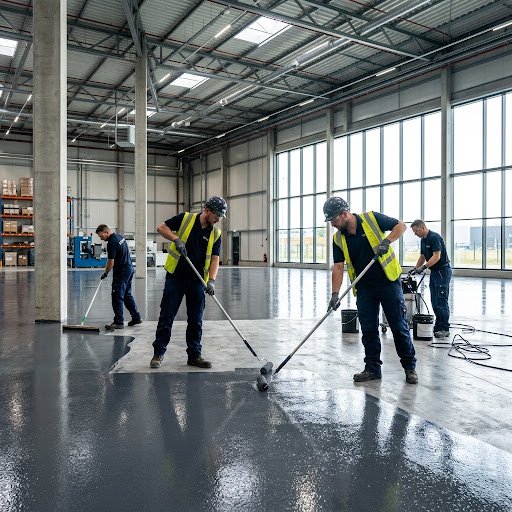
Professional application starts with surface profiling—using diamond grinding or shot blasting equipment to open the concrete surface and create the mechanical profile needed for adhesion. Any cracks or damage are addressed before a single drop of coating goes down.
Moisture testing comes next. If the slab has excess vapor transmission, the coating will lift. Professionals test for this and address it before application.
The coating is then applied in controlled layers, with each coat allowed to cure appropriately before the next is added. Decorative elements—broadcast flake, metallic pigments, or custom color blends—are incorporated during application for a finish that’s both protective and visually striking.
The entire process typically takes one to two days, depending on the size of the area and the coating system selected. The result is a surface that’s ready to perform immediately.
Long-Term Value: More Than Just Aesthetics
A coated concrete surface isn’t just easier on the eyes. The financial case for professional coating services is straightforward.
Repairing or replacing damaged concrete is expensive—and disruptive. A professionally coated surface dramatically reduces the likelihood of needing those repairs. The coating protects the structural integrity of the slab, extends its functional lifespan, and reduces ongoing maintenance costs.
Coated floors are also significantly easier to clean. The sealed surface doesn’t absorb spills—liquids bead up and wipe away. For commercial environments especially, this translates directly into reduced labor and cleaning product costs over time.
And from a property-value perspective, a finished, coated garage floor or a polished commercial space signals care and quality. It’s a detail that prospective buyers and tenants notice.
What to Expect When You Work With a Concrete Coating Service
Carbon Concrete Coatings delivers a complete solution from the first surface assessment through to the final topcoat—giving property owners a durable, professionally finished surface that protects the concrete beneath it while dramatically improving its appearance and long-term performance.
The service begins with an on-site consultation to evaluate the concrete’s existing condition, identify any areas requiring repair, and recommend the most appropriate coating system for the specific use case and environment.
Every project is approached with the same attention to preparation, application quality, and finish detail—regardless of size. That consistency is what separates a coating that lasts a decade from one that starts peeling after a season.
Concrete That Works Harder and Looks Better
The concrete beneath your feet has a longer life ahead of it than you might expect—provided it gets the protection it needs. A professional coating system doesn’t just preserve what’s there. It elevates it.
Surfaces that were functional become finished. Floors that were a liability become an asset. And concrete that was quietly deteriorating gets a new starting point—sealed, strengthened, and ready for whatever comes next.
If your concrete surfaces could use that kind of upgrade, the conversation starts with a professional assessment. The sooner the coating goes down, the more surface there is to save.