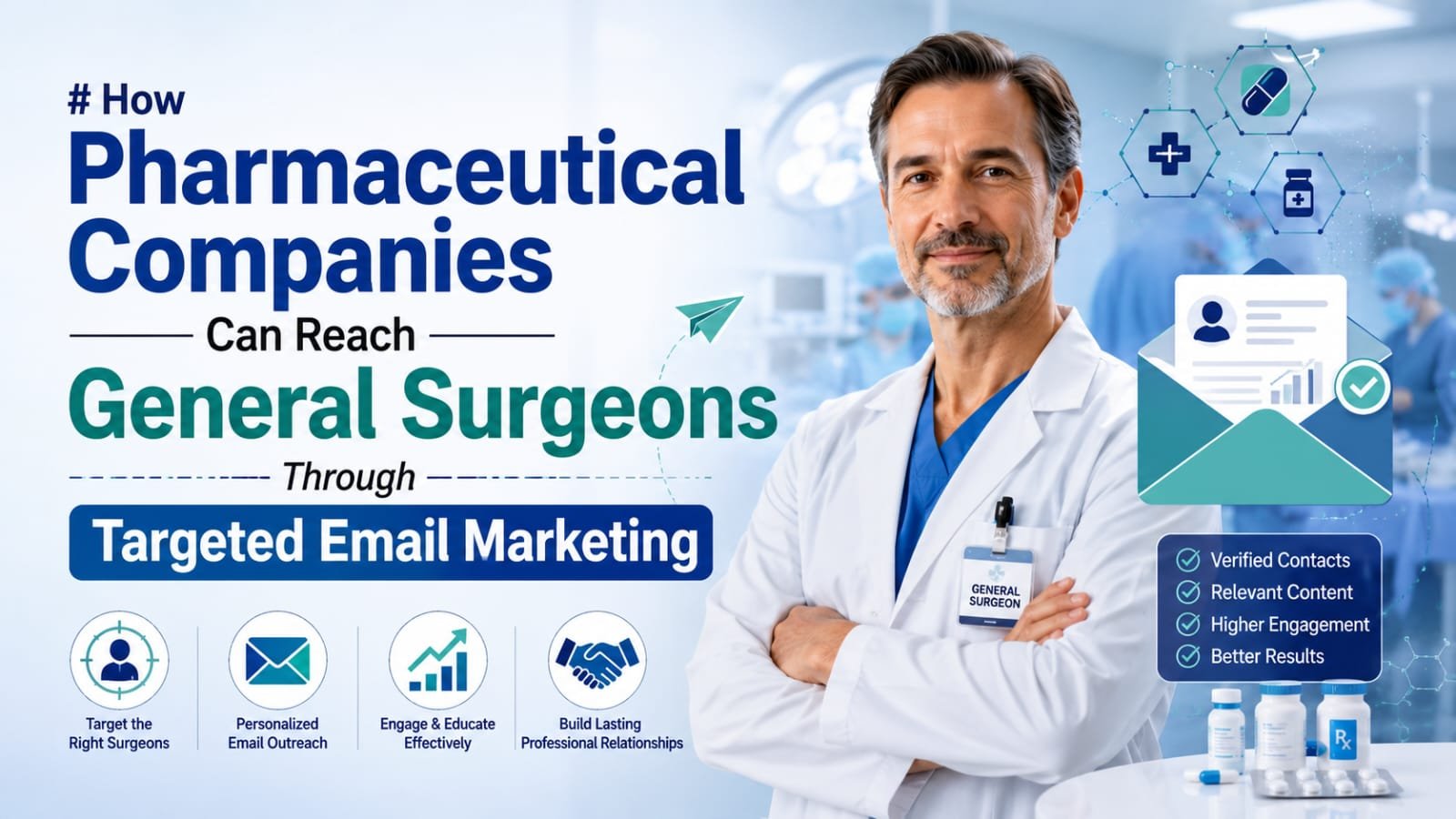
A focused strategy can improve communication relevance while reducing unnecessary outreach. By combining reliable professional data with valuable messaging, pharmaceutical companies can build more organized, informative, and measurable B2B marketing campaigns.
Why General Surgeons Are an Important Audience for Pharmaceutical Companies
General surgeons manage a wide range of surgical conditions and may interact with pharmaceutical products across different stages of patient care. Depending on their practice, they may be interested in areas such as perioperative care, pain management, infection prevention, surgical recovery, and other relevant therapeutic categories.
For pharmaceutical companies, reaching the appropriate professionals can make marketing campaigns more efficient. Instead of distributing communications across a large healthcare database, marketers can focus their efforts on professionals whose specialties and responsibilities align with the campaign.
The objective should not simply be to reach more contacts. It should be to reach relevant professionals with useful and appropriate information.
How Targeted Email Marketing Supports Pharmaceutical Outreach
Email marketing can provide pharmaceutical companies with a direct communication channel for professional audiences. A well-planned campaign can deliver educational resources, product information, clinical updates, webinars, and other relevant content.
Several factors influence campaign effectiveness:
- Audience relevance
- Accurate contact information
- Clear segmentation
- Useful content
- Personalization
- Appropriate frequency
- Email deliverability
- Compliance with applicable regulations
A targeted campaign is generally more useful than a broad campaign because the message can be aligned with the recipient’s professional context.
1. Build a Relevant General Surgeon Audience
The first step is identifying the audience that the campaign is intended to reach. Pharmaceutical companies may want to target general surgeons based on professional specialty, practice setting, geographic market, organization type, or other appropriate business criteria.
A specialized database can help marketers organize contacts according to these characteristics.
However, having a large database does not automatically produce better results. Data should be evaluated for accuracy, relevance, freshness, and appropriate permissions or legal basis for communication.
2. Segment Contacts Based on Relevant Criteria
Segmentation allows marketers to create different campaigns for different audience groups.
For example, a pharmaceutical company could segment general surgeons according to:
| Segmentation Factor | Example Marketing Application |
| Geographic location | Create region-specific campaigns |
| Practice setting | Tailor content for hospitals or private practices |
| Professional specialty | Deliver specialty-relevant resources |
| Organization type | Develop B2B-focused communications |
| Engagement level | Adjust follow-up communication |
| Content interests | Promote relevant educational resources |
Using a General Surgeons mailing List as part of a structured segmentation strategy can make campaigns more focused, provided the underlying data is accurate and used appropriately.
3. Create Educational Content
Healthcare professionals generally have limited time, so pharmaceutical email campaigns should provide clear value.
Instead of focusing entirely on promotional messaging, companies can create content such as:
- Clinical research summaries
- Product updates
- Educational guides
- Medical webinars
- Relevant industry developments
- Treatment-related resources
- Continuing education opportunities
- Conference and event information
Educational content can help establish a more informative relationship with the audience.
The content should also remain accurate, transparent, and consistent with applicable pharmaceutical marketing requirements.
4. Personalize Email Campaigns
Personalization can make email communication more relevant. Basic personalization may include the recipient’s name, professional specialty, organization, or geographic market.
More advanced personalization can involve delivering different content based on previous interactions or stated interests.
For example, a surgeon who has previously engaged with educational material about postoperative care may receive additional resources related to that subject rather than an unrelated campaign.
Individualizing each sentence is not the aim. Instead, personalization should help ensure that the information being delivered is relevant to the professional receiving it.
5. Use Clear and Informative Subject Lines
The subject line is one of the first elements recipients see. Pharmaceutical marketers should use straightforward subject lines that accurately describe the email.
Examples include:
- New Resources for Surgical Care Professionals
- Clinical Updates for General Surgery Teams
- Upcoming Webinar: Advances in Surgical Care
- New Educational Resources for General Surgeons
Avoid misleading subject lines, excessive promotional language, or claims that the email content cannot support.
A clear subject line helps recipients understand why the message may be relevant before opening it.
6. Develop Mobile-Friendly Emails
Many professionals access email from smartphones and tablets. Pharmaceutical companies should therefore ensure their campaigns work effectively across different screen sizes.
A mobile-friendly email should have:
- Simple formatting
- Readable text
- Clear headings
- Responsive design
- Easily accessible links
- Short, focused sections
- A visible call to action
A complicated design can distract from the primary message. For professional healthcare communication, clarity is often more valuable than excessive visual elements.
7. Use Appropriate Calls to Action
Every campaign should have a clear objective. That goal should be reflected in the call to action.
For example, pharmaceutical companies may invite general surgeons to:
- Read an educational resource
- Register for a webinar
- Download a clinical guide
- Visit a product information page
- Learn about a research update
- Request additional information
The call to action should be specific and easy to understand.
Rather than including several competing actions, marketers can prioritize one primary action and use secondary actions only when necessary.
8. Maintain High-Quality Contact Data
Data quality plays an important role in email marketing performance. Outdated or inaccurate information can contribute to bounced emails, poor engagement, and inefficient campaign spending.
Pharmaceutical companies using professional contact databases should regularly review information such as:
- Professional role
- Specialty
- Organization
- Email address
- Geographic information
- Employment status
- Engagement information
Email verification and routine database maintenance can help reduce invalid addresses and improve overall data quality.
However, marketers should avoid assuming that verified contact information alone establishes permission to send every type of communication. Data quality and legal compliance are separate considerations.
9. Follow Email Marketing and Pharmaceutical Compliance Requirements
Pharmaceutical email marketing requires particular attention to applicable laws, regulations, industry standards, privacy requirements, and internal policies.
Depending on the market and campaign, companies may need to address areas such as:
- Consent or another lawful basis for processing and communication
- Opt-out mechanisms
- Privacy requirements
- Accurate sender identification
- Promotional disclosure
- Product claim requirements
- Data protection
- Record keeping
Companies should involve their legal, regulatory, and compliance teams when developing campaigns involving pharmaceutical products or medical claims.
Compliance should be treated as part of campaign planning rather than something added after the campaign has been created.
10. Measure Campaign Performance
Tracking performance allows marketers to understand which campaigns are generating meaningful engagement.
Important metrics may include:
Delivery rate: Measures how successfully emails reach intended recipients.
Bounce rate: Identifies potential problems with contact data.
Open rate: Provides an indication of email engagement, although privacy technologies can make this metric less precise.
Click-through rate: Shows how frequently recipients interact with links.
Conversion rate: Measures completion of the campaign’s intended action.
Unsubscribe rate: Helps identify potential issues with audience relevance, frequency, or content.
Pharmaceutical companies should evaluate these metrics together rather than relying on one number.
Common Mistakes to Avoid
Targeted email marketing can become ineffective when campaigns are poorly planned. Common problems include:
Sending the Same Message to Everyone
General surgeons have different professional interests and responsibilities. A single generic campaign may not address the needs of every recipient.
Overly Promotional Messaging
Healthcare professionals may respond better to clear, informative content than aggressive promotional language.
Poor Data Maintenance
Outdated contact records can negatively affect deliverability and campaign efficiency.
Excessive Email Frequency
Sending too many messages can increase unsubscribes and reduce engagement.
Weak Calls to Action
If recipients cannot quickly understand what they are expected to do, campaign performance may suffer.
Ignoring Compliance
Pharmaceutical marketing involves additional regulatory considerations. Compliance should be incorporated into the campaign from the beginning.
The Role of Data in Targeted Pharmaceutical Marketing
Data can help pharmaceutical marketers move from broad communication toward more relevant audience strategies. A properly organized professional database can support audience segmentation, campaign planning, personalization, and performance analysis.
However, data should be treated as an enabler rather than the entire marketing strategy. A database cannot compensate for irrelevant content, poor messaging, weak campaign design, or inadequate compliance processes.
The strongest campaigns combine quality data + relevant content + thoughtful segmentation + responsible communication.
Conclusion
Pharmaceutical companies can use targeted email marketing to communicate more effectively with general surgeons by combining accurate audience data, relevant educational content, segmentation, personalization, and measurable campaign strategies. A carefully maintained General Surgeons mailing List can support these efforts when it is used responsibly and alongside appropriate privacy, consent, regulatory, and pharmaceutical marketing requirements.
The objective should ultimately be quality over quantity. Reaching the right professionals with useful, accurate, and relevant information can create a more sustainable approach to healthcare email marketing while helping pharmaceutical companies build meaningful professional engagement.