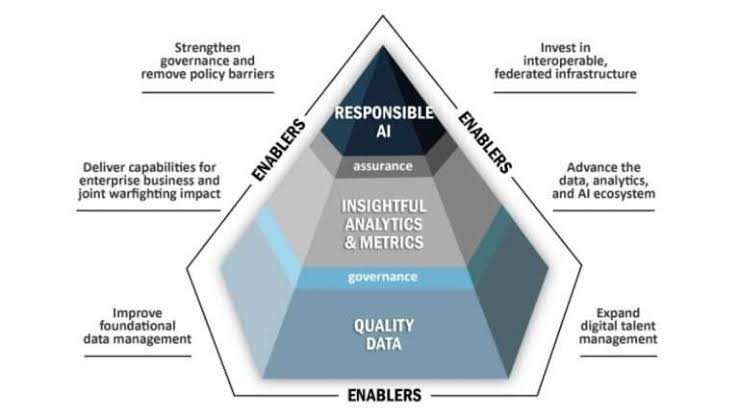
Artificial intelligence can help enterprises automate decisions, improve forecasting, personalise services, and identify new opportunities. However, these outcomes depend on the quality, context, accessibility, and governance of the information supporting each model. An Enterprise Data Strategy provides the structure needed to turn fragmented information into a dependable business asset.
Without this foundation, AI initiatives often remain limited to isolated pilots. Teams may spend more time locating, cleaning, and reconciling data than developing useful applications. Executives must therefore treat data strategy as a business priority rather than a technical project owned only by IT.
What Is an Enterprise Data Strategy?
An Enterprise Data Strategy is a long-term plan for collecting, managing, sharing, securing, and using data across an organisation. It aligns data investments with measurable goals while defining the people, processes, architecture, governance, and accountability required.
Connecting Data with Business Priorities
A practical strategy begins with business outcomes rather than platforms. Leadership teams should identify where trusted information can improve performance, such as:
-
Increasing forecasting accuracy
-
Reducing operational costs
-
Improving customer retention
-
Strengthening supply-chain resilience
-
Supporting regulatory reporting
-
Automating repetitive decisions
These priorities determine which data matters, how current it must be, who can access it, and which controls are necessary.
Executives should assign accountable owners, approve measurable use cases, and fund data improvement as an ongoing operating capability.
Why AI Readiness Begins with Trusted Data
AI readiness is not achieved by selecting a model or launching a proof of concept. Models require accurate, relevant, current, and governed information to produce dependable outputs.
An Enterprise Data Strategy helps organisations establish shared definitions, ownership standards, quality controls, access policies, and lineage. These elements make it easier to understand where information came from, how it was transformed, and whether it is suitable for a particular AI use case.
Business Context Matters
An AI system may identify patterns without fully understanding their operational meaning. Revenue, customer status, available inventory, and delivery performance may be calculated differently across departments.
A governed semantic layer can provide consistent business context for analytics and AI systems. Reliable outcomes also depend on data quality, permissions, lineage, monitoring, suitable models, and human oversight.
Executives should assess whether data definitions are consistent, sources are traceable, information is current, access rules are enforced, and outputs can be reviewed.
Data Modernisation Creates a Scalable Foundation
Many enterprises operate across legacy databases, cloud platforms, spreadsheets, departmental applications, and external services. These environments often create duplicate records, delayed reporting, and expensive integration work.
Data modernisation improves the architecture, tools, and operating model used to manage this information. It may involve cloud migration, database consolidation, API-based integration, data products, or governed data-fabric approaches.
Modernisation Is More Than Migration
Moving an outdated system to the cloud without improving its data model, governance, or integration design may simply transfer existing problems.
A strong Enterprise Data Strategy identifies which platforms should be retained, modernised, integrated, archived, or replaced. It also separates business-critical information from low-value data.
Enterprises using SAP HANA Consulting Services can modernise transactional and analytical workloads, connect SAP and third-party information, and build a scalable foundation for operational applications, advanced analytics, and time-sensitive use cases.
SAP HANA Cloud supports relational, graph, vector, spatial, JSON, and time-series data within a multi-model database environment. Platform value still depends on domain ownership, integration quality, adoption, and continuous governance.
Governance Turns Data into a Trusted Asset
Governance is sometimes viewed as a barrier to innovation. In practice, unclear ownership and inconsistent policies create delays because teams repeatedly question whether information is accurate, accessible, or approved for use.
Establishing Practical Accountability
An effective governance model should define:
-
Data owners and domain responsibilities
-
Quality thresholds and validation rules
-
Access and authorisation policies
-
Retention and deletion requirements
-
Sensitive-data classifications
-
Lineage and audit expectations
Governance should reflect risk. Public catalogue information does not require the same controls as financial records, employee data, or customer identities.
For AI programmes, governance must also cover training data, retrieval sources, model inputs, generated outputs, and human-review requirements.
Enterprise Analytics Supports Better Decisions
Enterprise analytics turns governed information into reports, forecasts, planning models, and operational insights. Its effectiveness depends on consistent definitions and timely access across functions.
An Enterprise Data Strategy creates a common foundation for finance, sales, operations, supply chain, human resources, and customer teams. Instead of maintaining conflicting reports, leaders can work from shared metrics and recognised sources.
Moving from Reporting to Action
Traditional reporting explains what has already happened. Modern analytics can support scenario modelling, predictive forecasting, anomaly detection, and operational recommendations.
However, more dashboards do not automatically create better decisions. Executives should prioritise metrics linked to actions, responsibilities, and measurable outcomes.
Organisations may use SAP Analytics Cloud Consulting Services to connect enterprise planning, business intelligence, predictive capabilities, and governed data within a coordinated decision-making environment.
Building an Enterprise Data Strategy for Digital Transformation
Digital transformation introduces new applications, automated workflows, connected products, and customer channels. Without coordinated data management, each programme can create another isolated information source.
A practical Enterprise Data Strategy should guide transformation through five stages:
-
Define priority business outcomes and AI use cases
-
Assess data assets, systems, and quality issues
-
Establish governance, ownership, and security controls
-
Modernise architecture and integrations in phases
-
Measure adoption, quality, analytics value, and AI outcomes
Leadership must also connect business domains, data teams, security specialists, analytics professionals, and AI developers.
Measuring Business Value
Data programmes should be measured through business and operational outcomes rather than technical completion alone.
Useful measures include:
-
Time required to prepare data for AI projects
-
Reduction in duplicate or inconsistent records
-
Faster reporting and planning cycles
-
Lower integration and maintenance costs
-
Improved forecasting or recommendation accuracy
-
Increased reuse of governed data products
These measures should be reviewed regularly as business models, regulations, and AI requirements evolve.
Creating the Foundation for AI-Driven Growth
An Enterprise Data Strategy gives organisations the trusted information, governance, architecture, and business context needed to move AI beyond experimentation. It connects data modernisation with enterprise analytics, digital transformation, and responsible decision-making.
The strongest strategies do not attempt to centralise every dataset or replace every system immediately. They prioritise measurable outcomes, modernise high-value areas in phases, and create standards that can scale across the organisation.
For AI-driven enterprises, data is not simply a technical input. It is the foundation that determines whether automation, analytics, and intelligent decisions can deliver reliable business value.