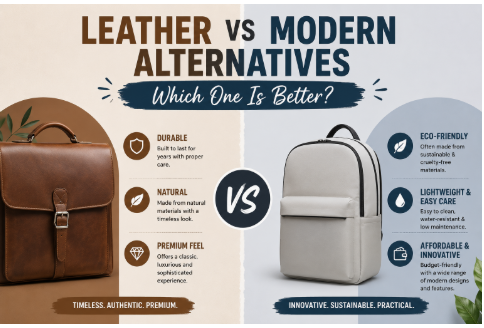
A bag broke on someone mid-trip last year. Not old, not abused, just eight months old. The zipper held fine. It was the material itself, “premium vegan leather,” that began to flake in thin pieces just at the handle, right at the spot it was needed most. When that time arrives, many people will switch over to real leather, not for fashion but for faith.
That’s not unusual.
It’s quite common to use a synthetic alternative past the return window. So let’s clear this up once and for all. Let’s compare leather to modern alternatives based on what they do, not what they’re sold as.
The Marketing Pitch vs The Actual Material
“Vegan leather,” “eco PU,” “premium synthetic,” these labels are designed to sound responsible and modern. And on a shelf, next to real leather, they often look nearly identical. That’s the whole trick.
However, if you remove the label, most of these are the same; a plastic coating that is pressed onto a fabric backing. It has no natural holding power whatsoever, but a thin layer that’s meant to look pretty for a short period of time. Once this layer begins to deteriorate, there is no layer below it to fall back on.
Why Synthetic Bags Fail Faster Than People Expect?
They’re not a defect; they’re how the material is constructed. Common coatings like PU and PVC tend to crack, peel, and harden over time, particularly when exposed to heat, friction or sunlight.
The majority of complaints are reported within the first 12 months, usually when people begin using the bag regularly. Once the protective coating starts to wear away, there’s no effective way to restore it. Unlike fabric or materials that can be repaired with customised patches, plastic cannot be reconditioned. The only practical solution is to replace the bag and start the cycle again.
What Real Leather Does Instead?
Leather behaves in a completely different way. It is not a coating; it is made of naturally woven fibers and does not break down from several directions; on the contrary, it gets better as it gets older. Scratches fade away over time, rather than scarring.
The surface picks up a patina, a more textured and toned surface which is only acquired through actual use. Moreover, leather can be cleaned, conditioned, and even repaired when it needs it, which synthetic materials cannot do.
Leather vs Modern Alternatives: A Side-by-Side Look
| Factor | Genuine Leather | Modern Synthetic Alternatives |
| Durability | Improves with age, resists tearing | Cracks and peels within 1-2 years |
| Reparability | Can be conditioned, cleaned, repaired | Usually not repairable once damaged |
| Long-term cost | One-time investment, lasts years | Repeated replacements add up |
| Appearance over time | Develops a rich patina | Fades, stiffens, or looks worn out |
| Everyday feel | Flexible, molds to use | Often stiff or plasticky over time |
| Long-term value | Higher upfront, lower lifetime cost | Lower upfront, higher lifetime cost |
The pattern is hard to ignore. A slightly lower price today doesn’t mean a better deal over five years.
The Real Reason People Assume Leather Is Expensive
Here’s the part most buyers get wrong. They think that any leather is considered to be a luxury item, so they go with the cheaper synthetic. The leather itself is not the reason for an increased price, it is the brand markup.
Many “premium” leather bags incorporate flashy logos, lush retail locations, and advertising to make them seem more expensive than they really are, not necessarily for their high-quality leather or honest stitching. Remove that markup and quality leather can definitely be found at a reasonable, regular price. The whole point of doing leather at an affordable price, is keeping the quality of the leather and avoiding the branding tax.
Where This Shows Up Clearly: The Leather Pilot Bag
This discussion is no longer theoretical when it comes to travel gear. Let’s take the leather pilot bag as an example. It’s placed in overhead storage, dragged across tarmacs, rained on, and opened dozens of times each month. That’s not showroom stress, that’s real stress.
A synthetic one may seem convincing on the initial couple of flights, but it will begin to wear quickly after that. A good quality leather pilot bag, on the contrary, will maintain its form and will actually look better each time you use it and it doesn’t have to cost an arm and a leg to achieve.
How Alaskan Leather Company Fits Into This
It’s the space Alaskan Leather Company was designed to fill. It’s about genuine full-grain hides and solid construction, and not the additional padding that other “luxury” brands add to the price for their brand. It is a testimony to the fact that leather doesn’t have to fall behind in terms of durability with modern alternatives anymore, and neither does it have to be as expensive as leather, if the unnecessary markup on leather is stripped away.
Quick Checklist Before You Choose
Before picking between leather and a synthetic alternative, ask yourself:
- Am I buying this to look good for a season, or to actually last for years?
- Would I still want this bag three year from now?
- Am I okay replacing a synthetic bag every twelve to eighteen months?
- Is the cheaper option actually saving me money, or just delaying the cost?
Most people, once they think it through honestly, land on leather, not because it’s fashionable, but because the math simply works out better.
Final Verdict
The modern alternatives beat on the lower price tag today and the great first impression. The rest is a victory achieved by leather, durability, reparability, true long-term value, and appearance over time. But with brands reducing the fat margins, you have to decide between quality leather and a price tag that’s not worth your while. The price of leather was always appropriate and never considered a luxury. It took a bit longer for them to catch on.